Success Story
How a water supply operator halved water loss from leaks through advanced analytics and efficient anomaly validation – saving 1.2 million Euros annually.
The municipal water supply operator of a European city with approximately half a million citizens faced challenges with water leakage due to their aging infrastructure. Many pipelines were several decades old and were prone to leaks and bursts. The operator had deployed hundreds of probes across the city that continuously collected data about their pipelines’ pressure, flow, and noise levels. However, achieving robust leakage detection was difficult due to strong local and daily fluctuations in water consumption, as well as seasonal variations and one-time effects. Due to the significant costs of physical inspections and excavations, operators required a high degree of confidence before taking measures. Therefore, minimizing false alarms was crucial. On the other hand, detecting and confirming leaks based on manual data analysis in their monitoring visualization was limited, difficult, and very time-consuming for the personnel.
The water supply operator envisioned a solution that combines automated detection of data anomalies with an efficient way for operators to analyze suspicious data patterns. The goal was to improve the detection of leaks and the confidence level before undertaking expensive actions such as excavations.
The data from the probes was stored in an AVEVA PI historian and was directly retrieved by Visplore from there. For automated detection of leaks, dashboards in Visplore indicated the occurrence of different types of How a water supply operator halved water loss from leaks through advanced analytics and efficient anomaly validation – saving 1.2 million Euros annually. Highlights 1.2 million Euros annual savings by reducing water loss from 15% to 8% 80% reduction in work hours spent on data analysis improved decision-making for costly maintenance interventions embraced by personnel due to transparency and ease of use anomalies for all probes at a glance. For example, probes that showed drifts or jumps in their flow rates during certain night hours over the past two weeks were highlighted. Additional anomaly detection measures utilized the predictive modeling capabilities of Visplore to highlight periods when the measured flow and pressure rates deviated for too long from the predicted values. For the validation of anomalies, graphical tools made it easy for operators to compare patterns to the data of nearby probes and to search for similar events in past data in a matter of seconds. The engineers soon adopted visualization types such as advanced interactive heatmaps and pattern profile views in their workflows when they realized the potential for faster and deeper validation of anomalies.
By adopting Visplore for detection and analysis, anomalies in sensor data from their probes no longer went unnoticed, and the operators could instantly assess their plausibility and criticality for making informed decisions early. This reduced the amount of work hours spent on data analysis by roughly 80%. The water supply operator also estimates that the water loss due to undetected leaks nearly halved from 15% to 8%. This means an annual reduction of water production costs of roughly 700.000€. Additional effects include improved water quality due to reduced risk of contamination, environmental impacts due to reduced water wastage, and higher customer satisfaction thanks to fewer service disruptions. Considering all these benefits, the total annual savings are estimated as 1.2 million Euros.
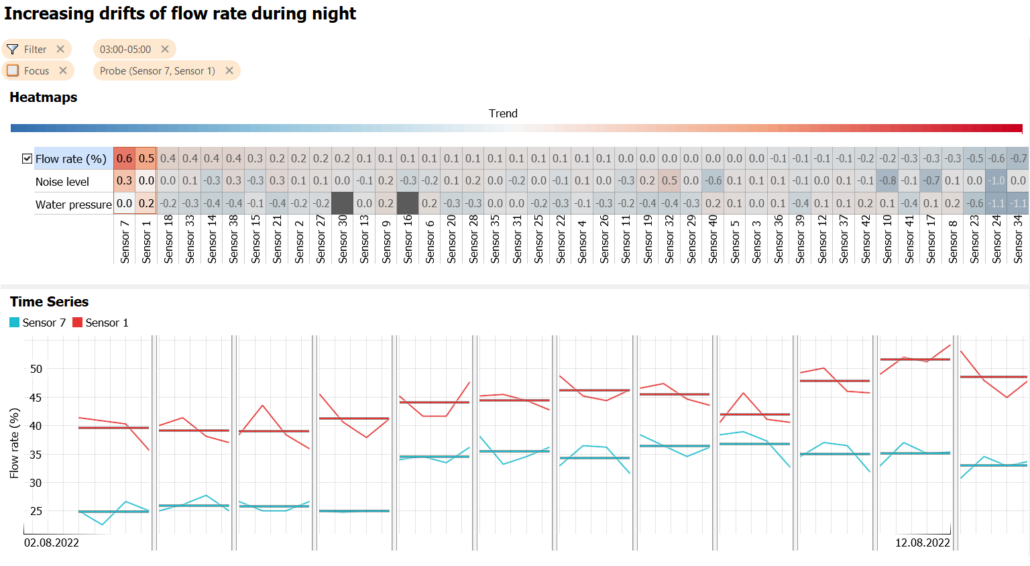
Top: Anomaly scores indicate drifts in flow rates, pressure, and noise during night hours for dozens of probes, which can be selected based on these scores.
Bottom: Two probes showing positive drifts in flow rate, the red one gradually, the blue one jumping suddenly.