Success Story – Data-driven maintenance for hydropower dam safety
How EnBW improved monitoring and predictive analytics for dam safety with Visplore.
How EnBW improved monitoring and predictive analytics for dam safety with Visplore.
The German energy supplier EnBW operates and maintains more than 60 hydropower plants to ensure clean energy supply in Germany’s southwest. Following investments in centralized data collection (AVEVA PI) and data science teams, EnBW encountered challenges with ad-hoc troubleshooting and deeper data analysis in the daily operation of subject-matter experts. Dam safety engineers, in particular, relied on Excel for data analysis, which made more complex tasks like predictive modeling and advanced monitoring inefficient and difficult to implement. In 2020, Visplore was introduced to empower engineers at EnBW with more advanced self-service analytics. Here are two successful use cases from EnBW’s Schwarzenbachtalsperre, demonstrating the value of Visplore for dam safety engineers of hydropower dams.
PROBLEM: Abnormal seepage in a dam can be a sign of internal erosion, piping or other issues affecting operation and safety. Field operators manually monitor seepage at multiple locations across the dam, but the probe holes may degrade over time due to wear or dirt accumulation. Moreover, anomalies in multiple neighboring measuring points may indicate undesired currents in the structure of the dam, requiring engineers to analyze historical data and contact engineers in the central office for maintenance decisions.
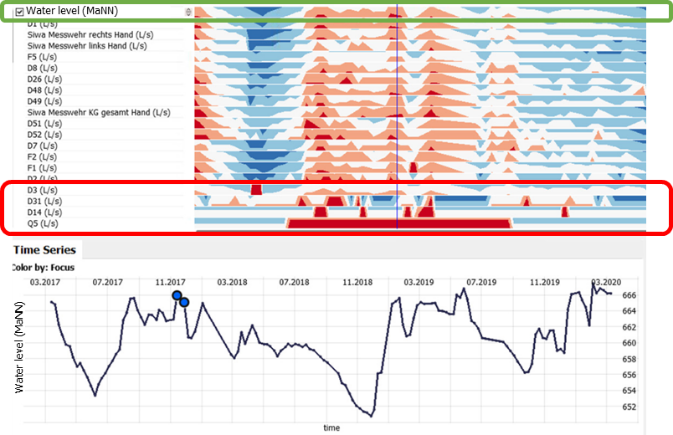
SOLUTION: Visplore provides the engineers with an overview of multiple probe locations over long historical periods. Since seepage is typically driven by reservoir water levels, Visplore helps correlate seepage data with these levels (top row in image) and other probes, quickly highlighting anomalies – see bottom 4 measuring points in the image for reference of different seepage behavior, which is independent of the water level. For automated monitoring, engineers can define regression models for each probe based on water levels and ambient conditions, without any programming. Dynamic thresholds further enable early detection of deviations from expected seepage patterns.
VALUE: With Visplore’s dashboards, engineers can investigate seepage issues much faster – reducing the analysis time from hours or days to just minutes. This improves communication with field operators and accelerates root-cause analysis, giving engineers a head-start in planning maintenance activities.
PROBLEM: The deformation of a dam is a key indicator of structural integrity that needs to be monitored for safety and operational efficiency. For this purpose, in the case of the Schwarzenbachtalsperre, pendulums have been installed inside the dam and are used to measure radial and tangential movements. Predefined limits for these movements existed, but had to be updated with the latest data. Therefore, engineers needed to develop a statistical model for the expected deformation from historical data – to define limits for the early detection of anomalies. Influencing factors were roughly known, but needed deeper understanding for defining a prediction model. Also additional sensors have been installed and needed to be considered
SOLUTION: Engineers imported several years of pendulum movement data and ambient conditions into Visplore to analyze dependencies. Irrelevant data such as pendulum disturbances were identified and excluded easily. Visplore then ranked the sensors by their impact on deformation and confirmed that outside temperature, not reservoir levels (which ranked 2nd) was the primary factor. Using these insights, engineers developed an initial regression model based on multiple temperature sensors and the reservoir level, which provided accurate predictions (see image below – predictions in red, and real data in black). However, when validating the model over several years, they found a consistent prediction error in autumn. Further analysis revealed that outside temperature had different effects in summer and winter, leading to false predictions in autumn. By incorporating this seasonal dependency into the model, prediction accuracy improved. Finally, deformation limits were defined from the model and deployed in AVEVA PI as formula tags for monitoring.
VALUE: The transparent modeling process gave engineers a deeper understanding of the dam deformation, which is helpful in communication with field operators, regulation authorities, and for monitoring. The model enables fast and accurate anomaly detection, increased situation awareness and earlier insights for maintenance planning. Moving forward, the engineers plan to scale this approach to monitor additional dams using Visplore’s automation features.