Beyond Dashboards: Why Fast Root-Cause Analysis Is the Real Lever for Industrial Performance
March 2026 – Dr. Harald Piringer
March 2026 – Dr. Harald Piringer
Many industrial companies have invested heavily in digitalization. KPIs, dashboards, monitoring platforms, and predictive maintenance are now standard, and transparency has improved significantly. Yet performance still drifts, scrap increases, energy efficiency drops. And despite years of digitalization, many organizations still rely on Excel analysis, senior expert intuition, and lengthy meetings to find root causes. This traditional troubleshooting process is slow, person-dependent, and costly. Worse, it often starts too late—when KPIs are already “red” and inefficiencies have accumulated.
This article argues why real economic leverage lies in standardizing data-driven root cause analysis when indicators turn “yellow.” This goes beyond predictive maintenance: it is holistic and applies to the entire process, not just individual assets, and can by made a matter of minutes with dedicated software tools focusing on troubleshooting. Organizations that standardize and accelerate industrial troubleshooting reduce hidden inefficiency costs, resolve issues faster, and unlock measurable financial impact.
In many plants, the pattern is familiar. It can be anything from a KPI drifting slightly, scrap rising by 0.8%, energy consumption per ton increasing subtly, or a startup taking longer than usual. At first glance, nothing seems too dramatic, since the traffic light is yellow and not (yet) red. Because production is still running, the deviation often does not trigger immediate structured analysis.
Instead, troubleshooting begins gradually. Data is exported and Excel sheets are built for engineers to manually compare time ranges. Teams schedule meetings, consult senior experts and debate hypotheses.
This approach is rooted in experience and dedication. But structurally, it is inefficient:
And while analysis is ongoing, the inefficiency continues.
The real cost of slow troubleshooting is the accumulated performance loss during delayed root cause identification.

Consider a simplified example:
A production unit generates €500,000 in value per day. A 1% efficiency loss caused by a subtle process drift equals €5,000 per day. If the deviation remains unresolved for 20 days because it never escalates beyond “manageable,” the hidden cost reaches €100,000.
In practice, nothing broke, and therefore no emergency occurred. But what about the small deviations? If left unexplained, they quietly accumulate significant financial impact.
In fact, across multiple lines, assets, and sites, these “yellow phase” inefficiencies can amount to millions annually. The largest economic potential does not lie in reacting faster to catastrophic failures, but in systematically eliminating minor but persistent performance drifts.
Predictive maintenance focuses on forecasting failure probabilities of specific assets, meaning it is asset-centric and relies on historical failure patterns and condition monitoring data. Fast root cause analysis at yellow KPI deviations goes beyond that in several ways:
1. It is process-centric, not asset-centric.
Performance deviations often result from complex interactions between process parameters, raw materials, environmental conditions, operating modes, and equipment behavior. The issue may not be an impending asset failure at all. It may be a parameter constellation, a product mix effect, or a startup sequence variation.
2. It is holistic.
Instead of predicting whether a pump might fail, it asks: Why did overall energy consumption increase? Why did yield drop for a specific product? Why do certain shifts show different behavior? It considers the entire system.
3. It does not depend on failure events.
Predictive maintenance requires historical failure data and stable patterns. In many environments, failures are rare, heterogeneous, or economically unjustified to model.
3. It addresses inefficiency, not only failure.
Most financial losses do not come from sudden breakdowns. They come from suboptimal operation, drift, longer startups, or minor quality deviations.
In other words: predictive maintenance is one important use case. Fast, structured troubleshooting of yellow deviations is a broader operational capability that includes—but is not limited to—maintenance questions.
When deviations occur, organizations often escalate them to central analytics or data science teams. While highly skilled, these teams face structural challenges:
Generic AI assistants and chatbots have increased in popularity when analyzing root causes, because they may support information retrieval or suggest analytical paths. However, troubleshooting is not a language interface problem. Engineers must compare, segment, test, and validate hypotheses interactively and transparently.
The challenge is not generating an answer. Efficient data driven root cause analysis needs an answer that is evidence-based, reproducible, and fast enough to prevent ongoing loss.
Deep troubleshooting has very specific requirements:
The problem is traditional dashboards are not designed for this, while Excel-based analysis is a slow and tedious process. Generic statistical tools are often detached from operational workflows and do not support a consistent root cause analysis process.
This is why specialized solutions have emerged that are purpose-built for fast, standardized industrial troubleshooting.
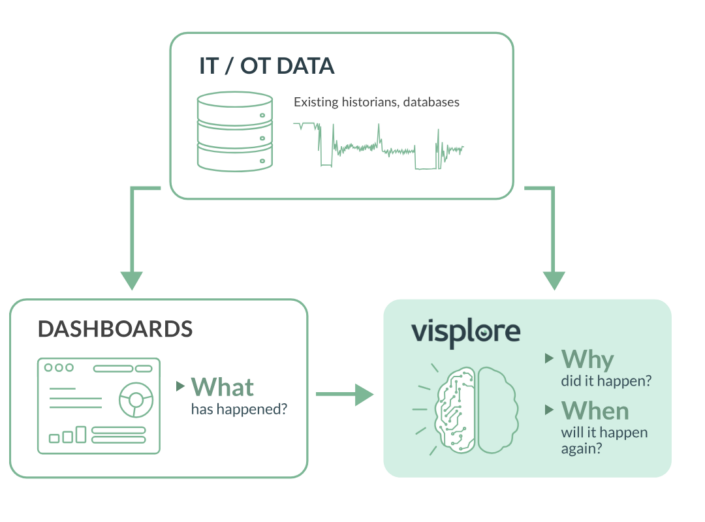
Tools such as Visplore are designed exactly around these requirements. They complement existing dashboards by enabling interactive, guided root-cause analysis across IT and OT data—directly usable by process engineers and operations experts.
The goal is to standardize and accelerate the transition from “something is off” to “we understand why“—with the root cause identified early enough to avoid accumulated losses.
When organizations can systematically analyze yellow KPI deviations within hours instead of weeks, several structural effects occur:
Reducing the duration of minor performance drift by even 30–50% can translate into substantial annual savings—without new assets, without new capacity, and without radical process changes. The return on investment is not a matter of spectacular AI breakthroughs; rather, it depends on eliminating hidden inefficiencies faster and more consistently.
Industrial digitalization has successfully improved visibility and prediction. But visibility without fast understanding leaves value untapped. The competitive advantage of the next stage lies in enabling rapid, structured root cause analysis, especially when traffic lights are yellow.
Predictive maintenance and dashboards remain an essential part of industrial performance. But it will be those organizations mastering standardized, holistic troubleshooting across their entire process landscape that will gain a deeper operational capability: knowing why something has changed and reacting early enough to make a financial difference.
In industrial performance management, the true leverage lies not in reacting faster to red alarms, but in understanding yellow signals before they turn red.

Harald Piringer studied informatics at the Vienna University of Technology and finished his PhD in 2011. For more than 10 years, Harald Piringer was the head of the Visual Analytics group at the VRVis research center in Vienna / Austria, where he did applied research in close collaboration with partners from industry, energy, healthcare, and other sectors. Harald Piringer (co-)authored more than 30 international publications in the fields of data visualization and visual analytics. In 2020, he co-founded the Visplore GmbH as its CEO.
If you want to experience live how Visplore can help you with root cause analysis across your entire industrial data, book a live demo.